

The Grimoire Feeling
There is a kind of book that does not just tell you a story. It seems to be hiding one.

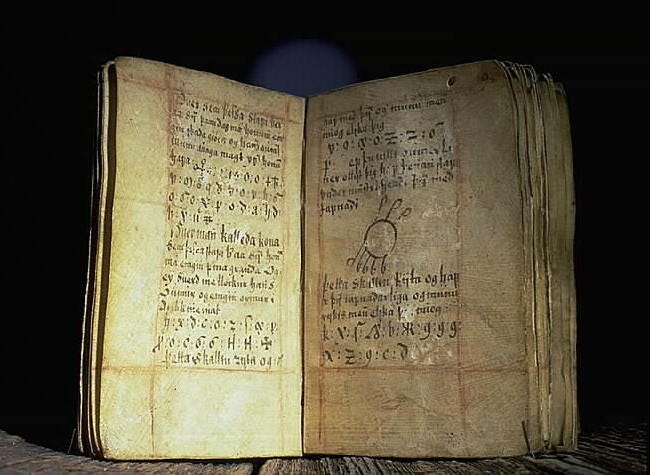
The Grimoire Feeling
There is a kind of book that does not just tell you a story. It seems to be hiding one. You read it and you get the sense that something is buried in the pages, a secret meaning that will only show itself if you pay close enough attention. The book stops being a thing you consume and becomes a thing you solve.
I have been reading Marguerite Young’s Miss MacIntosh, My Darling this way, and when I found the breadcrumbs to the Problem of Universals I sat in front of the computer and teared up. I started thinking of Young’s novel as a grimoire. A book of spells. Twelve hundred pages of looping, incantatory prose that train you, sentence by sentence, to read for a secret. And here is the strange part. Once you are reading that way, the secret starts to appear. Whether or not anyone put it there.
Young half-admits this. She had a minor in criminology, and she scatters references to famous mystery novels throughout the book. That detail can mean two things at once. It can mean that life is basically a mystery, unsolvable and beautiful. Or it can mean that the book itself is a mystery, with clues planted for the reader willing to play detective. I do not think you have to choose. I think she wants both running at the same time, and the doubling is the whole point.
What I did, over years, was develop her philosophy out of what felt buried in the book. I am not going to claim I am sure whether I found it or made it. I have come to think that is the wrong question, and I will get to why. But first I want to talk about the feeling itself, because once you know it you start finding it everywhere, and the other books that carry it are worth knowing.
The other grimoires
I’ll start with the ones I’ve read (or seen) and then on to others that follow the same pattern that I’ve added to my “to read” list. Realizing the couple I read years ago made the list gives me the first inkling of why I stuck with Young for so long in order to find what I felt was there.
Umberto Eco wrote two that belong here. The Name of the Rose (I only saw the movie) is a murder hidden inside a labyrinth of a library, the whole thing circling a lost book everyone is willing to kill for. And then there is Foucault’s Pendulum, which is the cautionary one. It is about men who get so good at finding hidden meaning that they invent a conspiracy out of nothing, and it eats them alive. I would read it right after you have fallen in love with the grimoire feeling, because it shows you the trapdoor under the floor you are standing on. I remember finishing it and sitting there with my first thoughts that would later become “here is enough”.
House of Leaves by Mark Z. Danielewski has ciphers, colored words, footnotes that swallow each other, and pages you have to turn sideways to read. This book was recommended to me and I loved it for its slow burn horror, vaguely reminiscent of the Backrooms movie which I also loved. I went on to read another one of his books that belongs here, Only Revolutions. If you’ve read it, you know.
Nabokov’s Pale Fire is a 999-line poem wrapped in the deranged commentary of a man who insists the poem is secretly about him and his lost kingdom. The real story is told nowhere. You have to build it yourself from clues scattered across the footnotes, and two careful readers will walk away holding two different books. Nabokov hands you the detective’s job and then refuses, forever, to confirm your solution.
Borges is the patron saint of all of this. “The Library of Babel,” “Tlön, Uqbar, Orbis Tertius,” “The Garden of Forking Paths.” Each one is built on the idea that somewhere out there is a book, or an encyclopedia, that contains the hidden order of everything. In Borges the thrill of that idea and the dread of it turn out to be the same feeling.
Pynchon’s The Crying of Lot 49 lives on the knife’s edge of whether the secret postal system its heroine keeps tracing is real or whether she is dreaming it up. You decode alongside her, and you are never told which one you did.
The Codex Seraphinianus by Luigi Serafini is the limit case: a full illustrated encyclopedia of an invented world, written in a script no one can read and no one was ever meant to. It is pure promise of meaning, with the meaning permanently locked away.
Why we love it
So why does this satisfy a reader so deeply? I think it comes down to one thing.
The fantasy is that meaning is hidden but recoverable. That is a quiet consolation against a much worse suspicion, the suspicion that meaning might just be absent. A grimoire promises that the secret is in there. And that promise makes the whole world feel authored instead of random. If a book was built with a hidden order, maybe everything was.
It also flatters you, in a way I think is mostly healthy. If the book rewards your attention, then your attention is worth something. You stop being a consumer and become a kind of initiate. The reading becomes an apprenticeship.
And there is an intimacy to it. A buried message feels like it was addressed to you, specifically. A private channel that the casual reader walks right past without noticing. To find it is to feel chosen.
What I would hold onto
Here is the one thing I keep coming back to. With Young, and with all of these books, it is usually impossible, and probably beside the point, to say whether you found the meaning or made it.
The grimoire reading is a collaboration. The book sets the conditions. You supply the attention. And the meaning actually lives in the meeting of the two, not in the book alone and not in your head alone. Foucault’s Pendulum, in the end, is about the danger of forgetting this. About mistaking what you brought to the book for what was always sitting there waiting.
But I want to be clear that the danger does not spoil the pleasure. The pleasure is completely real either way. The only discipline the grimoire asks of you is that you remember you were part of it. That you held the candle. That the spell needed a reader to be a spell at all.
That is what I found in Young. Or what I made there. I have stopped needing to know which.