

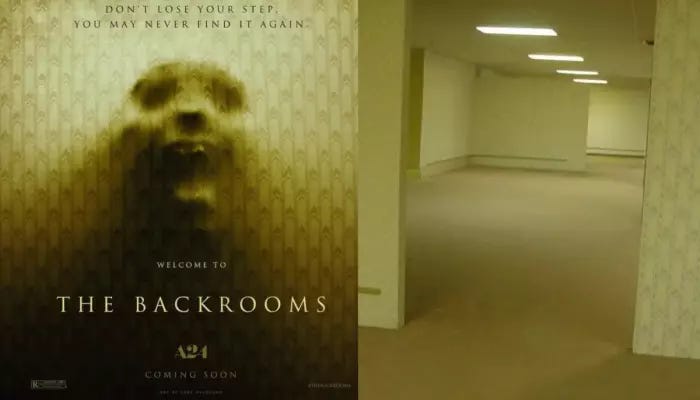
I’ve watched a lot of movies. I’ve read a lot of books. A lot of those movies and books were horror. I’m not exaggerating when I say, The Backrooms is the best horror movie I’ve ever seen.
*WARNING: SPOILERS AHEAD*
The Backrooms and the Terror of Staying Put
The best horror films don’t offer you a monster to flee. They offer you a condition you can’t escape. Kane Pixels’ The Backrooms (A24, 2024) does something darker than that: it offers you a condition you’re already living in, and makes you see it clearly for the first time.
The film is structured as found footage: a woman named Cara, a therapist, moves through an endless maze of liminal spaces (the spaces between meaningful places: hallways, empty rooms, corridors that repeat) after being pulled into them by a client. She documents what she sees. The spaces themselves are architectural nothing: drywall, fluorescent light, the default infrastructure of a building before it becomes anything. But the rooms don’t stay still. They shift. They descend. And the longer you’re inside them, the more your brain begins to fail.
This is where the film’s real horror lives, and it’s a horror that works directly on the nervous system.
The Prediction Machine in Collapse
Your brain is a prediction engine. Every moment, it’s running models of what should be happening next: where the wall will be, what color the room is, what sound comes after what. When the prediction is accurate, your brain experiences the world as coherent and safe. When there’s a mismatch between prediction and reality, something in you tightens.
The liminal space is the perfect weapon against this system. It’s not wrong enough to be clearly dangerous. It’s close enough to the ordinary world that your brain keeps expecting it to cohere into something recognizable. But it never does. The hallway is always slightly too long. The room empties in a way that doesn’t match any architectural logic. The light is fluorescent but wrong. Your prediction machinery keeps firing, and keeps failing, and keeps firing again.
The tension never resolves. That’s the horror.
The film understands this and uses it. We watch Cara move through spaces that her brain (and ours) keeps expecting to become something, and never does. The camera lingers. It refuses to cut away. You feel the unbearable accumulation of moments that don’t add up to anything. The weight of staying in a gap that never closes.
This is what the therapist is trying to escape when she offers hypnotherapy to her clients: the loops of the mind that keep firing prediction patterns that don’t match reality. She wants to reprogram them. Fix the mismatch. Restore coherence. She is offering, in other words, a way out of the present moment and into a corrected version of experience.
But the Backrooms won’t let her. It is the loop she’s trying to escape. It’s the gap between what should be and what is, made spatial, made inescapable.
The Descent Without Arrival
There is a sequence in the film where the camera travels down through a living room, scene by scene, the same room changing as it descends. The furniture is there, then less there, then gone. The walls remain but become bare. The space strips down to its skeleton until there’s almost nothing left: just the architectural frame and a small hole in the corner. Then the hole becomes a doorway, and there are more rooms beyond it.
The logic here is the opposite of spiritual depth. In the wellness promise, if you go deeper into yourself, practice harder, dig far enough, you’ll find something: a core, an essential self, the real you beneath the conditioning. That descent is supposed to lead to revelation and release.
This descent leads nowhere. It empties. The rooms don’t contain meaning; they contain only more rooms. The architecture continues. There is no bottom, no center, no arrival. Just the endless fact of space itself, stripped of everything but duration and the strange refusal to resolve.
This is the visual language of Marguerite Young’s prose in Miss MacIntosh, My Darling. Young’s sentences don’t move toward meaning; they accumulate. They layer. They refuse singular interpretation. Her narrator, Vera Cartwheel, doesn’t arrive at understanding; she becomes sedimented by the weight of what has happened to her, formed moment by moment, image by image, into a self that is multiple and unfinished and precisely where she is.
The Backrooms does this in pure form: visual sedimentation. The descent shows you that there is no escape into clarity, no transcendence waiting below. Just the continuation of being where you are, moment after moment, room after room.
The Layering of Evidence
The bodies in the Backrooms are layered. You see accumulated eyes. Accumulated hands. Parts of people pressing against each other in the same space, over time, until they become almost abstract: the evidence of presence rather than presence itself. It is a visual representation of what Young calls the alluvial self: the self formed through time and accumulation, not transcendence. You don’t escape your past and return unchanged. You become sedimented by it. The passages reshape you through duration and repetition.
The therapist understands this intimately. In one sequence, she watches her childhood house being demolished. The house where her mother kept her confined, where paranoia built walls around both of them. The house is torn down to make way for a residential tower. She cannot save it. She cannot reprogram or process her way out of what happened there. All she manages to save is a handprint from the driveway: her mother’s hands, the physical evidence of confinement.
She carries this handprint into the Backrooms.
This is grief as material, not as something to be worked through and released. This is the ordinary ground of a life: loss that doesn’t resolve, confinement that doesn’t release you, hands that shaped you and continue to shape you long after the walls come down. The handprint is not healing. It’s witness. It’s the refusal to pretend that what happened can be transcended.
Why This Matters Now
The wellness industry offers escape from loops, from trauma, from the unbearable mismatch between what is and what should be. It offers ascent. Higher vibration. Expanded consciousness. Your best self. It promises that if you practice hard enough, pay enough, surrender enough, you can reprogram yourself into safety and coherence and meaning.
The Backrooms offers something different: the recognition that you are already trapped in the present moment, already caught in the gap between prediction and reality, already made of time and loss and the things that won’t resolve. It offers no door. It offers no corrected version of yourself waiting on the other side of practice.
It offers only this: the clarity of seeing what is already true. You are here. The rooms continue. The past doesn’t disappear; it accumulates. Your mother’s hands shaped you and you carry them. The prediction machine keeps firing and keeps failing. The gap doesn’t close.
This is horror because it refuses to offer transcendence. It refuses to promise that if you go deep enough or practice hard enough or understand yourself well enough, you will finally escape. It says: you are already in the present moment, and it won’t release you because there is nowhere else to go.
That refusal is also, paradoxically, the only ground that’s actually solid.
The Ordinary Ground Beyond the Backrooms
The therapist doesn’t escape. The film doesn’t offer redemption through understanding or integration or spiritual development. What it offers is something quieter: the recognition of what is actually here. The spaces you inhabit. The hands that shaped you. The people who were here before you, accumulating in the same impossible present.
In the ordinary world, after the film ends, this means something precise. It means that your mental loops don’t need to be fixed in order for your life to count. That your trauma doesn’t need to be transcended. That the things you’ve lost don’t need to resolve into meaning. That you are enough, exactly as you are right now, formed by time and loss and the weight of what you carry.
The Backrooms is the most accurate portrait of what the wellness industry won’t tell you: that there is nowhere to go. That the present moment is not a waiting room. That the ordinary ground is the only ground.
And the horror of that recognition is also its liberation.
The Backrooms is in limited theatrical release and will be available on streaming. If you’re interested in the neuroscience of prediction and perception, Donald Hoffman and Anil Seth have both written extensively on how the brain constructs reality; Seth’s work on the prediction error and perceptual binding is particularly relevant to understanding why liminal spaces feel so disturbing at the neurological level.
Avoiding reading this until I see it, but I am stoked!