

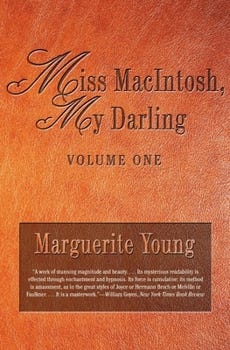
The morning light settles across my lap from the window behind me in a soft, predictable wash, illuminating the book that has become a permanent resident of my life. To open Miss MacIntosh, My Darling for a sixth reading is not merely to return to a story, but to step back into a vast, breathing architecture of the mind—one that has been my constant companion through seven years of patient, steady labor.
Seven years is a long time to spend inside a single vision. It is the span of time it takes for every cell in the human body to replace itself, and in many ways, I feel that same quiet transformation has occurred in my own work. When I first began this journey, the novel felt like a beautiful, impenetrable fog. I felt like I was drowning and sometimes bored with the drowning at the same time. Today, that fog and drowning sensation has cleared into the “Radical Immanence” of the everyday—a realization that the most profound philosophical systems aren’t found in the clouds, but in the unfinished, ordinary present we inhabit together.
This sixth pass feels different. There is a warmth here now, an invitation I might have missed in the early years of rigorous mapping and investigative research. The prose no longer feels like a challenge to be conquered; it feels like a conversation with a long-lost friend. I find myself weaving my own history into the sedimentary layers of Young’s rhythmic sentences.
For seven years I have spent countless hours tracing these chapter-by-chapter arcs, yet the work remains as vibrant as ever. This is the beauty of a complete philosophical system: it doesn’t exhaust itself. It simply waits for you to grow enough to see what was always there.
As I turn to page one once more, I am reminded that there is no such thing as a “finished” understanding. There is only the crossing point where the writer meets the reader, and where the work of seven years turns into the joy of a single, shared moment.
Welcome back to the journey. There is, as always, enough right here.