

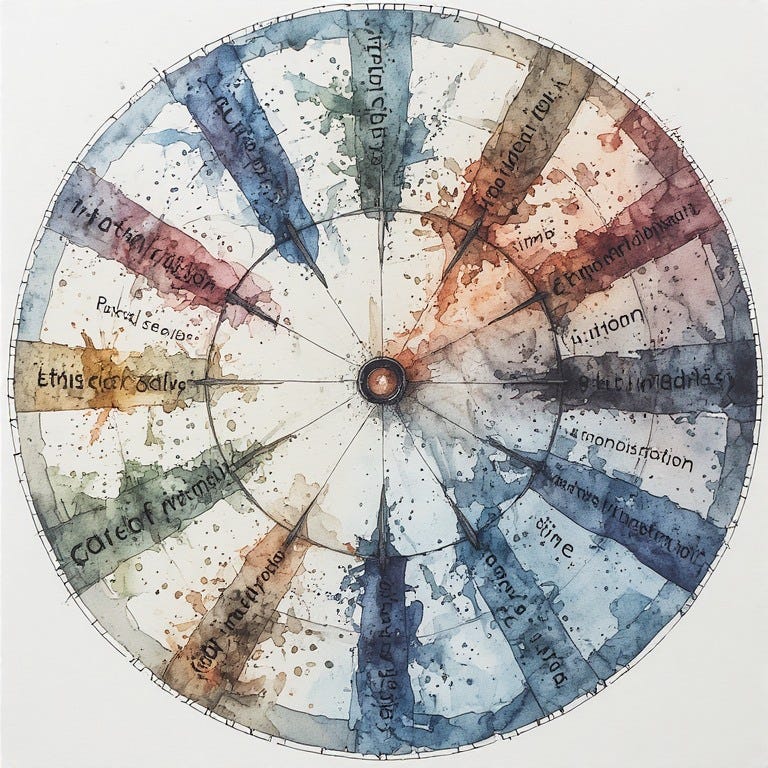
Welcome to this critical investigation into the philosophical system of Miss MacIntosh, My Darling, and why its structural commitments provide the ultimate epistemological framework for political resistance.
When Marguerite Young published her monumental 1,198-page novel Miss MacIntosh, My Darling in 1965, the Western critical establishment suffered a collective failure of imagination. Faced with her dense, recursive prose, mainstream critics filed her away under the dismissive categories of experimental fiction, eccentricity, or mere stylistic excess. They treated her text as a novel containing dense aesthetic flourishes rather than what it truly is: a rigorous, internally consistent philosophical system that intentionally chose fiction as its only honest formal medium.
As we re-examine her work today, we see that Young was operating within an intellectual landscape that had not yet developed the vocabulary to receive her. Appearing just prior to the American arrival of European poststructuralism, her critique of the unified subject and her attention to how form carries argument were profoundly lonely, predictive achievements . She built a framework I have explored and called Radical Immanence, structured around ten original load-bearing pillars and a newly uncovered eleventh axis.
This series will offer a deep, critical dive into each of these pillars through the philosophers she was critiquing or who built their foundational system upon her work, unbeknownst to them. We will treat Young with the academic rigor she deserves, contextualizing her work alongside major figures in political theory, metaphysics, and ethics.
Before we analyze the individual pillars week by week, we must understand the overarching political stakes of her system. When unified into a singular architecture, Young’s philosophical positions reveal themselves as a devastating, systematic dismantling of the authoritarian playbook. Authoritarianism relies on a fixed epistemological baseline: rigid sorting mechanisms, the naturalization of artificial hierarchies, and the enforcement of absolute scripts. Young’s architecture jams this machinery at every point.
1. The Plural Self: William James, Gertrude Stein, Gloria Anzaldua, Hannah Arendt
Where the Western tradition from Descartes to liberal political theory has protected the fiction of the unified, rational subject, Young demonstrates that the self is inherently plural. Authoritarian movements function as sorting technologies, requiring simplified populations that can be cleanly divided into binary categories. By conceptualizing identity as a shifting crowd of internal selves, Young renders the individual fundamentally un-sortable, disrupting the primary mechanism of regime discipline.
2. Illusion as Primary: Plato, Descartes, Peter Berger and Thomas Luckmann, Patricia Hill Collins
Dominant political structures maintain power by “naturalizing” their own arrangements, presenting historical choices and exclusions as the immutable laws of nature. Young refutes the classic Platonic division between reality and illusion, arguing that reality is merely a consensus illusion . Once a population recognizes that the dominant social structure is a human invention rather than a natural law, the performance of the regime loses its objective authority and becomes open to radical reconstruction.
3. Grief as Permanent Weather: Walter Benjamin, Judith Butler, Indigenous Philosophy
Tyranny demands that its subjects participate in a shallow script of national triumph, forcing a public performance of recovery and resilience over structural wounds. Young repositions grief as an ongoing atmospheric condition rather than a temporary stage to be resolved. By refusing the false closure of a manufactured national narrative, honest public grief keeps the wreckage of historical injustice permanently visible, demanding ongoing systemic reckoning.
4. The Witness: Simone Weil, Iris Murdoch, Hannah Arendt
Oppressive movements scale up by convincing everyday citizens to look away from state cruelty, or to process that cruelty through a comforting ideological filter. Young’s ethical core is the Witness: the subject who refuses to look away, choosing to stay in the room with structural contradictions without flinching or rushing to a clean conclusion. This unblinking attention directly undermines the systemic obfuscation required by authoritarian statecraft.
5. Recursive Construction: Alfred North Whitehead, Democratic Revision, Feminist Political Construction
Fascism always presents a frozen, permanent blueprint for society, promising an absolute ideological “arrival”. Young counters this with process philosophy, celebrating the recursive attempt: the cycle of building provisionally, evaluating the output, and looping back to rebuild with fresh insight. This commitment to institutional fluidity ensures that social structures remain responsive and prevents power from solidifying into frozen tyranny.
6. Situated Knowledge: Donna Haraway, Adrienne Rich, Sandra Harding
Deceptive leaders run a political “long con” by claiming to possess the completed, flawless answers to complex human problems. Young positions the unfinished not as a failure, but as a supreme form of honesty and integrity. When we treat our governing structures as incomplete, living arguments rather than untouchable, sacred texts, we preserve the capacity for vital course correction.
7. Community as Held Difference: Hannah Arendt, Mikhail Bakhtin, Coalition Politics
To maintain control from a centralized locus of power, regimes attempt to erase or pathologize populations existing outside standard social categories . Drawing on concepts that rhyme with Hannah Arendt’s theory of plurality, Young argues that the margins are exactly where the artificial seams of the social real become legible. Centering the marginal exposes the cracks in the regime’s constructed landscape, transforming the outcast from an anomaly into vital evidence.
8. Sedimentary Time: Walter Benjamin, John McPhee, Indigenous Philosophy
Regimes utilize a linear, progressive view of time to assert that past historical violations are safely settled and out of sight . Young presents a geological model of time: the past does not recede, but sediments beneath the present moment. Acknowledging that history is an active substrate prevents the state from treating current property, economic, and social hierarchies as neutral or fair .
9. Language as Construction: Gertrude Stein, Adrienne Rich, Dale Spender through Judith Butler
Propaganda operates through a rigid, simplified political grammar designed to erase nuanced human experience and police thought. Inheriting the linguistic experiments of Gertrude Stein, Young uses sprawling, circular syntax to resist the grammatical commitment to fixed, sortable nouns . By keeping language under active construction and honoring our exact coordinates, we dismantle the semantic abstractions that authoritarians use to dominate the public mind.
10. The Unfinished as Integrity: Walter Benjamin, Process Philosophy, Young as Supreme Exemplar
Dictators almost universally appeal to an external, grand “beyond”: a mythical past era, an ultimate leader, or a supreme destiny: to justify immediate, localized state violence . Young pulls the rug out from this tactic by anchoring the sacred entirely within the ordinary world . When the sacred is recognized in the immediate environment and everyday subjects, there is no room left for external abstractions to dictate human worth or validate state violence.
11. The Crossing Point vs. The Isolated Present
Authoritarians isolate populations inside a short-sighted present-moment frame, accelerating resource extraction and institutional dismantling because the future is treated as a sentimental fiction. The hidden center of Young’s system is the vertical line of transmission running directly through the self. As an alluvial subject, you are the exact crossing point where the weight of historical deposits meets the ground of the unborn generations. This orientation enforces a profound, unyielding intergenerational accountability that cannot be shaken by the transient political winds of a regime.
“The sentence hasn’t ended. The work hasn’t ended. Neither has the world that made the work necessary.” - The Crossing Point
As we step into this architecture together, we invite you to look at literature not merely as an aesthetic escape, but as a critical laboratory for human survival. Young provides us with something far better than cheap comfort: she offers the unyielding companionship of a thinker who stared directly into the abyss of the mid-century landscape and refused to look away, refused to simplify, and refused to conclude .
If you are interested in a rigorous, deeply contextualized reclamation of forgotten literature and political philosophy, please consider subscribing, sharing this introductory essay, and leaving your thoughts in the comments below.